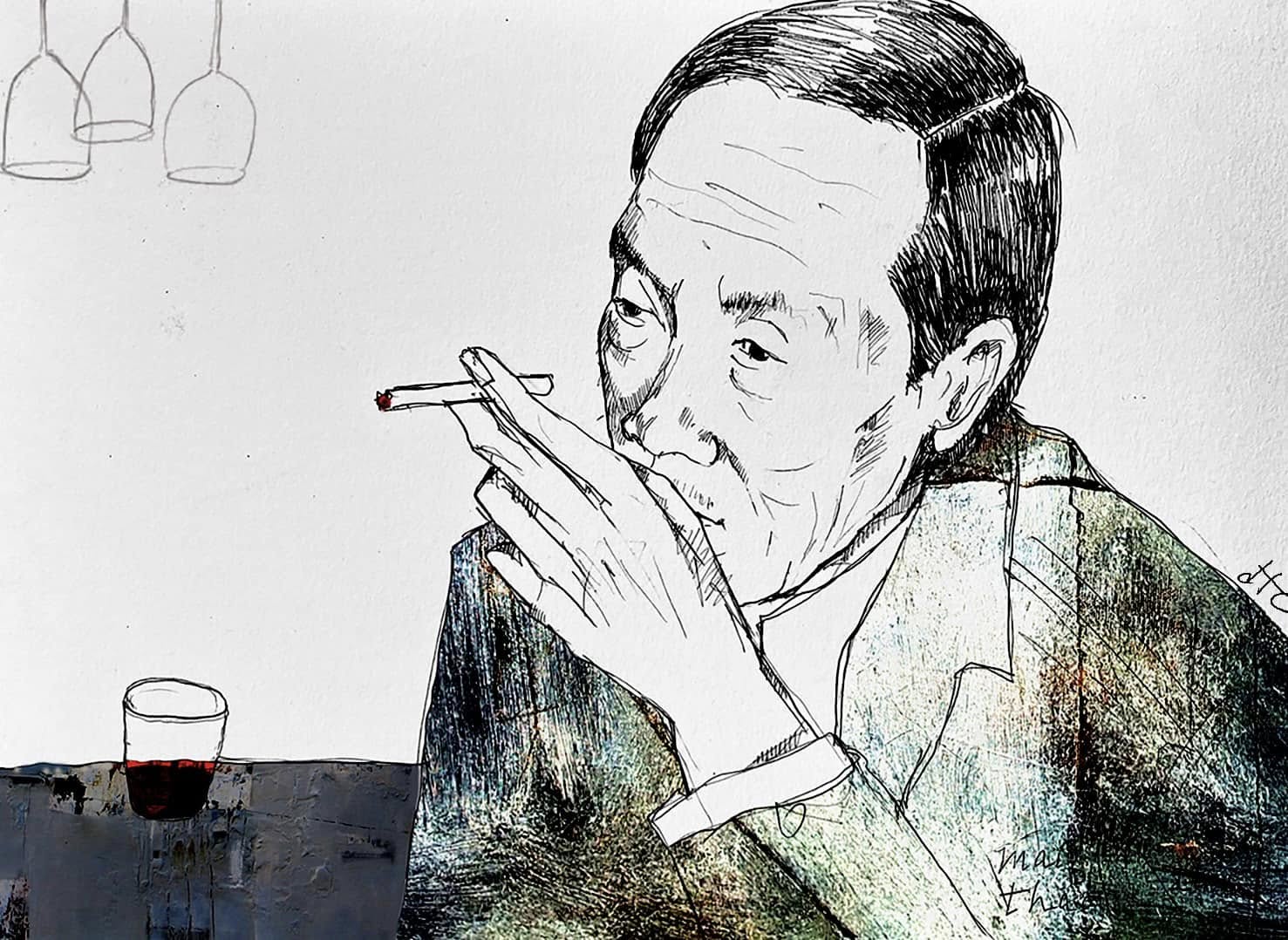
A poem in Vietnamese by Mai Thảo
Translator: Nguyễn Thị Phương Trâm
I can see my name in the street signs
My history in a thousand chapters
In the Ganges, a grain of sand
The heart of an ocean
I can see myself in the shrines
A sacred statue in a thousand parks
Smoke and incense of adoration
Scent from the origin of oblivion
I can see the stars crowding in the sky
O Big Dipper upon your dais for me wait thee
O bioluminescent plankton from the depths of the sea
Burn please, burn brighter just for me
I can see God there on my way
Sleeping Buddha in the meadow and sacred fields
In a realm of the imagination
And hell yes, is other people!
I can see the axis of the earth ceasing
Wrapped around an unmoving earth is a sky unmoving
So unmoving in my heart is a dusty speck
Ceased, stopped dancing
I can see that I am the night amid the day
I am the day through an endless night
The consistent darkness of the sun and moon
The moment the flamingoes out in the wet and cold scattered
I can see humanity bursting into tears
Watching the sight of me disappear
Heaven and earth weeping blood
Born from my blood, born from my tears
I can see the velvet curtains closing
The curtains lowering. A century left without out play
It’s okay, I can always flip and play the fool
I’m sick of being crazy, it’s not cool
I can see my body dangling from a tree
Fast asleep in all that green as far as one can see
And why not, why can’t it just be
Where at the round about there is nothing left for me.
ta thấy hình ta những miếu đền
Ta thấy tên ta những bảng đường
Đời ta, sử chép cả ngàn chương
Sao không, hạt cát sông Hằng ấy[1]
Còn chứa trong lòng cả đại dương
Ta thấy hình ta những miếu đền
Tượng thờ nghìn bệ những công viên
Sao không, khói với hương sùng kính
Đều ngát thơm từ huyệt lãng quên
Ta thấy muôn sao đứng kín trời
Chờ ta, Bắc Đẩu trở về ngôi
Sao không, một điểm lân tinh vẫn
Cháy được lên từ đáy thẳm khơi
Ta thấy đường ta Chúa hiện hình
Vườn ta Phật ngủ, ngõ thần linh
Sao không, tâm thức riêng bờ cõi
Địa ngục ngươi là, kẻ khác ơi![2]
Ta thấy nơi ta trục đất ngừng
Và cùng một lúc trục trời ngưng
Sao không, hạt bụi trong lòng trục
Cũng đủ vòng quay phải đứng dừng
Ta thấy ta đêm giữa sáng ngày
Ta ngày giữa tối thẳm đêm dài
Sao không, nhật nguyệt đều tăm tối
Tự thuở chim hồng rét mướt bay
Ta thấy nhân gian bỗng khóc oà
Nhìn hình ta khuất bóng ta xa
Sao không, huyết lệ trong trời đất
Là phát sinh từ huyết lệ ta
Ta thấy rèm nhung khép lại rồi
Hạ màn. Thế kỷ hết trò chơi
Sao không, quay gót, tên hề đã
Chán một trò điên diễn với người
Ta thấy ta treo cổ dưới cành
Rất hiền giấc ngủ giữa rừng xanh
Sao không, sao chẳng không là vậy
Khi chẳng còn chi ở khúc quanh.
[1] William Blake
[2] Jean-Paul Sartre
Mai Thảo [1927-1998] real name is Nguyen Dang Quy, another pen name: Nguyen Dang, he was born on June 8, 1927 in Con market, Quan Phuong Ha commune, Hai Hau district, Nam Dinh province (originally from Tho Khoi village, Gia Lam district, Bac Ninh province, the same hometown and related to the painter Le Thi Luu), his father was a merchant and wealthy landowner. Mai Thao absorbed his mother’s love of literature from Bac Ninh. As a child, he studied at a village school, went to Nam Dinh high school and then Hanoi (studied at Do Huu Vi school, later Chu Van An). In 1945, he followed the school to Hung Yen. When the war broke out in 1946, the family evacuated from Hanoi to Con market, in the “House of the Salt Water Region”, from then on Mai Thao left home to Thanh Hoa to join the resistance, wrote for newspapers, participated in art troupes traveling everywhere from Lien Khu Ba, Lien Khu Tu to the Viet Bac resistance zone. This period left a deep mark on his literature. In 1951, Mai Thao abandoned the resistance and went into the city to do business. In 1954, he migrated to the South. He wrote short stories for the newspapers Dan Chu, Lua Viet, and Nguoi Viet. He was the editor-in-chief of the newspapers Sang Tao (1956), Nghe Thuat (1965), and from 1974, he oversaw the Van newspaper. He participated in the literature and art programs of radio stations in Saigon from 1960 to 1975. On December 4, 1977, Mai Thao crossed the sea. After 7 days and nights at sea, the boat arrived at Pulau Besar, Malaysia. In early 1978, he was sponsored by his brother to go to the United States. Shortly after, he collaborated with Thanh Nam’s Dat Moi newspaper and several other overseas newspapers. In July 1982, he republished the Van magazine, and was editor-in-chief until 1996, when due to health problems, he handed it over to Nguyen Xuan Hoang; Two years later he died in Santa Ana, California on January 10, 1998.
Nguyễn Thị Phương Trâm, the blogger, poet, and translator, was born in 1971 in Phu Nhuan, Saigon, Vietnam. The pharmacist currently lives and works in Western Sydney, Australia.

 Nguyễn Thị Phương Trâm
😁😁😁
LikeLiked by 1 person
Beautiful poem.
LikeLiked by 1 person
This is a truly mesmerizing and evocative poem—mystical, layered, and profoundly introspective. 🌌✨
What stands out most is the sweeping scope of imagery. You move effortlessly from the intimate and personal (“my name in the street signs,” “my history in a thousand chapters”) to the cosmic and eternal (“the stars crowding in the sky,” “the axis of the earth ceasing”). It creates a rhythm that feels both grounded in human history and transcendent in spiritual imagination.
LikeLiked by 1 person
Thank you for saying that, his short stories are a lot harder to translate. Your kind thoughts are truthfully encouraging.
LikeLiked by 1 person