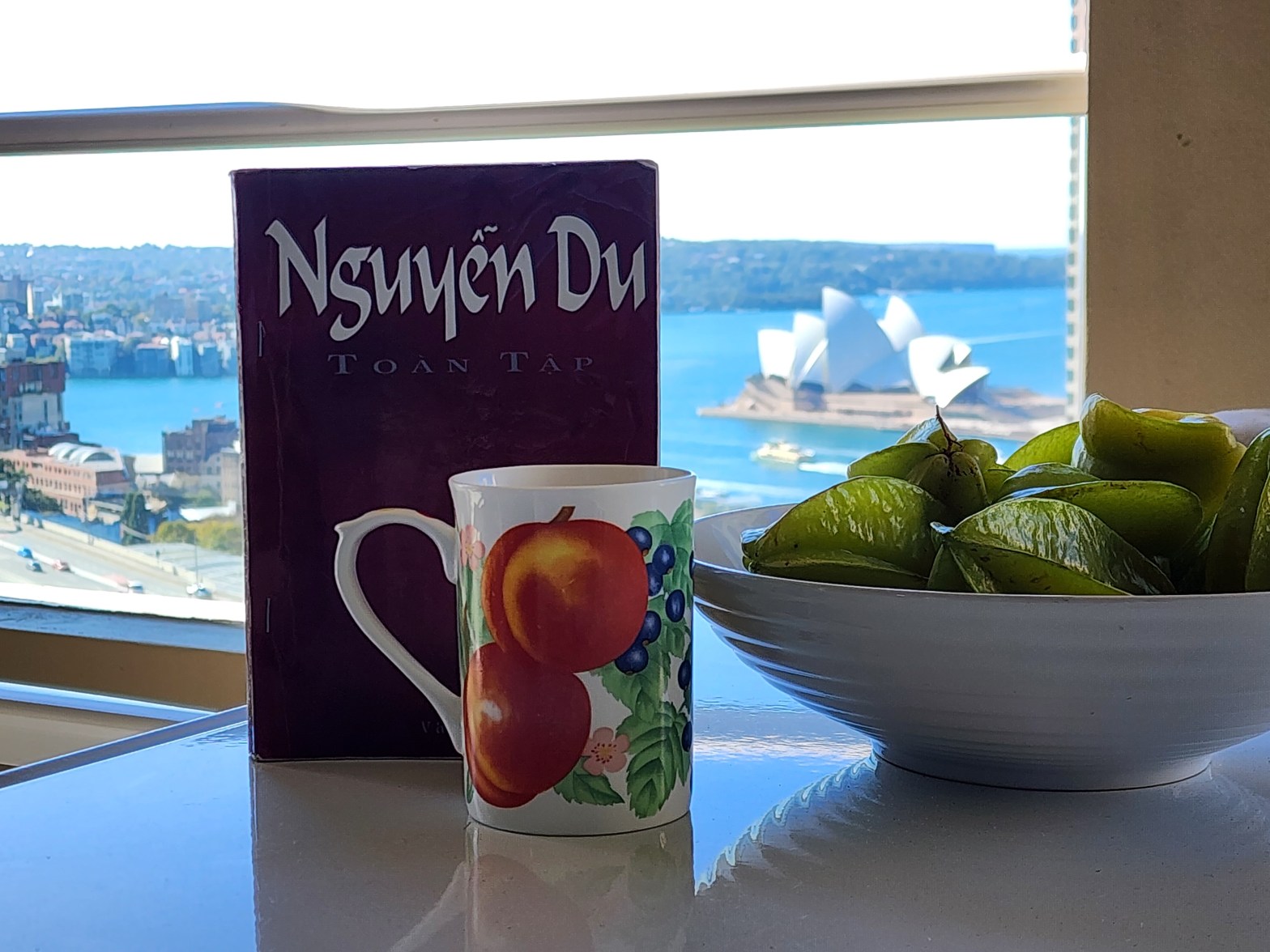
NGUYỄN DU

Sydney Autumn 2025 [Nguyễn Thị Phương Trâm]

An adaptation by Nguyễn Thị Phương Trâm

  • Cuộc đối thoại với Cụ Du
  • Kiều stumbling on Đoạn Tiên’s grave – Kiều thăm mộ Đạm Tiên [1-244]
  • Kiều met/gặp Kim Trọng [245-572]
  • Kiều sold herself to pay off her father’s debt – Kiều bán mình chuộc cha [573-804]
  • Kiều rơi vào tay Tú Bà & Mã Giám Sinh [805-1056]
  • Kiều mắc lừa Sở Khanh [1057-1274]
  • Kiều met/gặp Thúc Sinh [1275-1472]
  • Kiều & Hoạn Thư [1473-1704]
  • Kiều & Hoạn Thư (cont) [1705-2028]
  • Kiều met/gặp Từ Hải [2029-2288]
  • Kiều’s revenge – Kiều báo thù [2289-2418]
  • Từ Hải cheated by Hồ Tôn Hiến, Kiều’s attempted suicide – Từ Hải mắc lừa Hồ Tôn Hiến, Kiều tự vẫn [2419-2738]
  • Kim Trọng’s search for Kiều – Kim Trọng đi tìm Kiều [2739-2972]
  • Kiều & Kim Trọng reunited – Kiều & Kim Trọng đoàn tụ [2973-3254]

Nguyến Du [1766-1820] courtesy name Tố Như and art name Thanh Hiên, is a celebrated Vietnamese poet and musician. He is most known for writing the epic poem The Tale of Kiều.

Nguyễn Thị Phương Trâm, the blogger, poet, and translator, was born in 1971 in Phu Nhuan, Saigon, Vietnam. The pharmacist currently lives and works in Western Sydney, Australia.

deliriously obsessed were the yellow flowers  | Lê Vĩnh Tài

Ban Me Thuot, Vietnam. Nguyễn Thị Phương Trâm

A poem in Vietnamese by Lê Vĩnh Tài
Translator: Nguyễn Thị Phương Trâm

deliriously obsessed were the yellow flowers
the stars cried because of the disgusting way I fell in love with you
you were caught red-handed in daylight
a January kiss, in a dream covered in cigarette smoke

no one had the nerve to kiss you
you’re left alone burning and smoking like a tobacco pipe
stuck in a room
full of smoke

some say you’re a genius
they pulled out from the right to love you
some say that it’s bullshit you’re a genius
they inserted themselves to enable your return
as they cried and tripped all over each other

it’s absolutely disgusting but I loved you still
long after they were dead and gone
and you’re still around somewhere
amongst the people

FEBRUARY 2022
_____

những bông hoa màu vàng mê sảng
những ngôi sao khóc vì cái cách khủng khiếp mà tôi đã yêu bạn
trong ánh sáng bạn bị bắt gặp quả tang
trong nụ hôn tháng giêng và giấc mơ toàn mùi thuốc lá

không ai dám hôn bạn
để bạn một mình bị cháy như cái tẩu
và bị mắc kẹt trong một căn phòng
toàn khói

cũng có người nói bạn là một nhân tài
họ rút ra để dành quyền yêu bạn
cũng có người nói nhân tài cái cc
họ đút vào để bạn trở về
với bọn họ vẫn đang khóc và thay nhau gục ngã

thật khủng khiếp nhưng tôi vẫn yêu bạn
rất lâu sau khi bọn họ chết
và bạn vẫn còn lê lết
với nhân dân


Lê Vĩnh Tài, the poet and translator born in 1966 in Buon Ma Thuot, Daklak, Vietnam. The retired doctor is still a resident of the Western Highlands and a businessman in Buon Ma Thuot.

Nguyễn Thị Phương Trâm, the blogger, poet, and translator, was born in 1971 in Phu Nhuan, Saigon, Vietnam. The pharmacist currently lives and works in Western Sydney, Australia.

all the poems were in sky blue  | Lê Vĩnh Tài

St. Joseph, Hanoi, Vietnam. Photography by Nguyễn Thị Phương Trâm

A poem in Vietnamese by Lê Vĩnh Tài
Translator: Nguyễn Thị Phương Trâm

all the poems were in sky blue
only the one that had been raped was red

all the moons were blue
only the sunrise was a watery orange

all the green leaves lowered their heads smiling
human beings were always the ones looking up crying

the day Mother was on the saddle of a golden wind
flying, turned into a silvery star

with a dream that one day all the poems will unite
in a song in blue
—–
April 2022

tất cả các bài thơ đều màu xanh da trời
chỉ bài thơ bị hiếp dâm màu đỏ

tất cả mặt trăng cũng đều màu xanh
chỉ có bình minh màu cam pha loãng

tất cả lá cây màu xanh đều cúi xuống mỉm cười
chỉ con người hay nhìn lên và khóc

ngày Mẹ cưỡi cơn gió màu vàng
bay lên trời thành ngôi sao màu bạc

mơ một ngày tất cả bài thơ đều hát
chỉ một màu xanh


Lê Vĩnh Tài, the poet and translator born in 1966 in Buon Ma Thuot, Daklak, Vietnam. The retired doctor is still a resident of the Western Highlands and a businessman in Buon Ma Thuot.

Nguyễn Thị Phương Trâm, the blogger, poet, and translator, was born in 1971 in Phu Nhuan, Saigon, Vietnam. The pharmacist currently lives and works in Western Sydney, Australia.

369 | Lê Vĩnh Tài

A poem in English & Vietnamese by Lê Vĩnh Tài
Art: Đinh Trường Chinh

i reach for the stars
and bring them back
put them in your eyes

I keep them behind your eyelids
for fear
you change
your mind

anh với tới những vì sao
và mang chúng về
đặt vào mắt em

anh nhốt chúng lại sau mí mắt
vì sợ
em đổi
ý

With arms outstretched so high I
Seize the stars to bring them down
Then lay in your eyes.

Behind your lids I lock them up
Out of my fear
For your heart’s
Flight.
(Đoàn Duy’s translation)


Đoàn Duy, the translator is currently living in Vietnam.

Lê Vĩnh Tài, the poet and translator born in 1966 in Buon Ma Thuot, Daklak, Vietnam. The retired doctor is still a resident of the Western Highlands and a businessman in Buon Ma Thuot.

the evidence | Lê Vĩnh Tài

Ben Thanh Market, Vietnam. Photography: Nguyễn Thị Phương Trâm

A short story in Vietnamese by Lê Vĩnh Tài
Translator: Nguyễn Thị Phương Trâm

The lady is fully aware that the gentleman is very liberal in bed at the moment with a dog.

After he had finished he ran downstairs, holding onto a wound on his chest. Dear lady, I have been shot…

The lady, draped across the daybed, jumped up, and ran to the kitchen. In the end, the gentleman has been shot, mother…

Standing by the door, her mother watched the gentleman’s blood drip onto the timber floor.

We should call the police, the gentleman’s voice petering. Police? His mother cried. Son, have you forgotten about what the police did to our family?

The dog is over there, the lady pointed.

No, we will not call the police, his mother ordered.

The gentleman left the staircase, and staggered slowly towards his mother. His mother said to him: can you recall how liberal you were in bed with the stranger, son. The gentleman replied: Yes, I remember, I was completely liberal. His mother continued: it’s like a metaphor poets use to cover up a poem.

The dog was still on the staircase. Its eyes stray from the cat. Its whiskers were rather thin. Its front gloved paw was holding onto a gun, still smoking. I suggest we bury him in the backyard, it announced adding, as long as no one else sees.

We only bury dead people there, his mother said, my son is not dead. He just needs to rest for a while. The dog turned its head suddenly towards the incredulous growl of the cat. It stared at the puddle of blood at the bottom of the staircase. His mother also turned towards it as the gentleman ran towards the blood, his fist tightening on a bag of poisonous dog bait. You should tear the bag open, his mother said. A cat from the kitchen jumped onto the daybed and finished the lady’s half eaten eggs on a plate. His mother gave her a sideward glance.

It’s not my dog, she said, it’s the guy next door’s dog.

That very night, they took the gentleman to the back of the house. The lady put the spade back into the tool shed. His mother said, we need lime, we shouldn’t have such an odd smell in the house.

The next morning was a full moon. The lady and his mother sat outside in the backyard. They were dressed for the temple, both holding a plate of egg and smoked meat. They ate in silence, and stared unblinking at the freshly dug mound of dirt. Now and then the lady would throw the dog a piece of meat. It was time for the temple, his mother said, then pushed the plate full of egg barely touched aside.

As soon as his mother went inside, the dog hopped onto the table. It was watchful for a minute, after hearing the sound of the car engine, the rubber tires rolling across the gravel on the driveway, the car was gone, lowering its head calmly, licking clean the eggs on both of the women’s plates.

It doesn’t care about the number of casualties increasing by the day. The truth was that the gentleman died because of his work. The dog knows that the lady will spare some time to ponder over what has happened between it and the gentleman, so it may forever be a reminder in the minds of humanity.

Because, it would often ask: Sir, where are you from?

April 2021

DẤU VẾT 

Nàng biết, chàng và con chó đang chơi trò tự do trên giường.

Sau đó chàng chạy xuống cầu thang, tay ép chặt vào vết thương trên ngực. Ta đã bị bắn, nàng ôi… 

Nàng đang ngả người trên ghế dài, bật dậy chạy vào bếp. Cuối cùng rồi chàng cũng bị bắn, mẹ ơi… 

Mẹ đứng trước cửa, nhìn máu từ ngực chàng chảy lên sàn gỗ. 

Chúng ta cần gọi cảnh sát, giọng chàng yếu ớt. Cảnh sát? Mẹ kêu lên. Con có nhớ những gì cảnh sát từng làm cho gia đình chúng ta?

Con chó phía xa kia kìa, nàng nói.

Không, chúng ta không gọi cảnh sát, mẹ nói.

Chàng ra khỏi cầu thang và lảo đảo đi về phía mẹ. Mẹ nói: Khi con chơi trò tự do trên giường với người lạ, con phải nhớ. Chàng nói: Con nhớ, con đã hoàn toàn tự do. Mẹ nói: Đó như một ẩn dụ mà thi sĩ vẫn chơi bên ngoài bài thơ. 

Con chó vẫn ở cầu thang. Đôi mắt nó rời khỏi con mèo. Ria mép nó hơi mỏng. Một chân trước (có đeo găng) của nó đang cầm súng, nòng còn bốc khói. Tôi đề nghị chôn ở sân sau, nó nói thêm, nếu như không có ai nhìn thấy.

Chúng ta chỉ chôn người chết ở đây, mẹ nói, và con trai ta không chết. Nó chỉ cần nghỉ ngơi một chút. Có tiếng mèo gào nghe khủng khiếp và con chó quay đầu về phía đó. Nó nhìn vệt máu dưới chân cầu thang. Mẹ nhìn theo và thấy chàng cũng lao về phía nó, tay nắm chặt túi bã chó. Có lẽ con nên xé cái túi ra, mẹ nói. Một con mèo từ nhà bếp nhảy lên chiếc ghế dài để ăn dĩa trứng còn lại của nàng. Mẹ lườm nàng.

Nó không phải là con chó của con, nàng nói, nó là con chó của anh hàng xóm.

Đêm đó họ mang chàng ra phía sau nhà. Nàng cất vào tủ quần áo một cái xẻng. Mẹ nói Chúng ta cần ít vôi, trong nhà không nên có mùi lạ. 

Sáng hôm sau là ngày rằm. Nàng và mẹ ngồi ở bàn ăn ngoài trời. Họ mặc quần áo đi lễ chùa và mỗi người đều có một đĩa thịt xông khói và trứng trước mặt. Họ ăn trong im lặng, nhìn chằm chằm đám đất còn tươi ở sân sau. Đôi khi nàng ném một miếng thịt xông khói cho con chó. Đã đến lúc đi lễ chùa, mẹ nói, và đẩy đĩa trứng đang ăn dang dở của mình sang một bên. 

Sau khi mẹ và nàng vào nhà, con chó nhảy lên bàn. Nó ngước lên nghe ngóng khoảng một phút và khi tiếng xe đã ra khỏi nhà, lăn bánh trên đường sỏi, nó cúi xuống liếm đĩa trứng của mẹ và nàng sạch sẽ.

Nó không muốn mọi người lo ngại về số thương vong ngày càng tăng. Nó nghĩ chàng đã chết khi làm nhiệm vụ. Nó biết nàng và mẹ sẽ dành một ít thời gian suy nghĩ về trò chơi mà nó cùng chàng trải qua, để những suy nghĩ vẫn còn lại trong ký ức của con người.

Vì nó hay hỏi: Thưa ông, ông từ đâu tới?

Lê Vĩnh Tài, the poet and translator born in 1966 in Buon Ma Thuot, Daklak, Vietnam. The retired doctor is still a resident of the Western Highlands and a businessman in Buon Ma Thuot.

Nguyễn Thị Phương Trâm, the blogger, poet, and translator, was born in 1971 in Phu Nhuan, Saigon, Vietnam. The pharmacist currently lives and works in Western Sydney, Australia.

Big mean huge  | Lê Vĩnh Tài

Sydney China Town, Australia. Photography: Nguyễn Thị Phương Trâm

A poem in Vietnamese by Lê Vĩnh Tài
Translator: Nguyễn Thị Phương Trâm

The poet got a message that she was shopping at the BigP centre

Big means huge. As for P?

She told him off for being crude. But he was merely pondering the letter P. It has Petering ambition. It has no desire for Personal autonomy or Progressive market share, or a better than a Pass in exams. It doesn’t have to be a good citizen of the People or some Popular singer…

It’s only one part of a nameless Person, lining up to Pay for a small Pallet to rest his back after a long working day. It’s the Pitiful tears shed knowing we still love each other. It’s the light Pat on the back goodbyes like the flicker of a small flame in the dark when he’s dying for a cigarette.

Thi sĩ nhận được tin nhắn là nàng đang mua sắm ở siêu thị BigC

Big là to & lớn. Còn chữ C?

Nàng mắng thi sĩ vì sợ những ý nghĩ tục tĩu của chàng. Nhưng chàng đang nghĩ về chữ C. Nó không có Chút gì tham vọng. Nó không yêu cầu gì về Chủ quyền lãnh thổ hay Con số của thị phần, hoặc phải tăng điểm trong Cuộc thi & xếp hạng gì đó. Nó không cần phải là một Công dân danh dự hay Ca sĩ thời danh…

Nó chỉ là một phần của Con người vô danh, đang xếp hàng tính tiền sau khi mua về cho mình một Cái tấm nệm nhỏ đủ để ngả lưng sau một ngày kiếm ăn mệt lả. Nó là Cái giọt nước mắt ứa ra để biết vẫn còn thương nhau. Nó là Cái vẫy tay chia xa như chàng hay bật tia lửa nhỏ trong bóng tối mỗi khi thèm thuốc lá.

—-

May 2020


Lê Vĩnh Tài, the poet and translator born in 1966 in Buon Ma Thuot, Daklak, Vietnam. The retired doctor is still a resident of the Western Highlands and a businessman in Buon Ma Thuot.

Nguyễn Thị Phương Trâm, the blogger, poet, and translator, was born in 1971 in Phu Nhuan, Saigon, Vietnam. The pharmacist currently lives and works in Western Sydney, Australia.

April | Lê Vĩnh Tài

SONY ILCE-7SM2 ƒ/2.81/40024 mmISO100. Photography: Nguyễn Thị Phương Trâm

A poem in Vietnamese by Lê Vĩnh Tài
Translator: Nguyễn Thị Phương Trâm

a falling teardrop at sunrise
you’re leaning into a small
soft
very soft sound

April
you’re watching the bougainvillaea bloom beyond endearment
at the gate
under its shade
a faithful character of endless tragedy

the street silent
only the doctors are working
rescuing wheezing clusters of clouds

the past fading into a chaotic memoir
cold and bare packets of instant noodles
scattered on the kitchen bench

April
your heart
thrown about on the factory floor emptied of human power
the labourers were gone
not the end of a shift but the end of labour

the inspiration of a poem
not a consumable product
not an income
a poem is not cash
even when the poets wants the top dollars
the poor nodding off
holding onto a green permit
there together in tears
at the closed
bars

a child dancing
bouncing around town
the feeble notes of sadness and death
hunger isn’t imagined
we farewell the grey days
mid note

we’re lost
in the song
we’re blowing the horn like the call of ravens
the call of old village elders long ago

the ravens on fire from the trees flying
separating tree seedlings from the soil
shuddering in the furrows
reeds separating from clouds
spirit separating from inebriation
as you would separate from the light
appearing to say: welcome
oh first day of April

summer is now as soft as a spider web
belongs to women
mornings consuming coffee till it’s grey
nightfall hiding in the garden
disappearing in goodbyes

not in death that we welcome each other
welcome the king
welcome the prince
welcome the queen
when the king is dead
the newspaper boy scuttering through the streets
shouting out the hot new
no one lives twice

April
all shall hold on tightly to
the shatter pieces of the Sun
rising or falling
on our hair…

THÁNG 4

bình minh rơi giọt nước mắt
bạn cúi xuống nghe thấy một âm thanh
nhẹ
nhỏ và quá nhẹ

tháng tư
bạn nhìn những tàn hoa giấy trước cổng nở hoa
hơn cả tình yêu, dưới bóng râm
có một người kiên nhẫn vào vai đau buồn vô tận

thành phố im vắng
chỉ những bác sĩ vẫn còn làm việc
cứu những đám mây đang khó thở

quá khứ dần phai nhạt, ký ức rơi vào rối loạn
những gói mì còn sót lại trong bếp
lạnh lẽo, trần trụi

tháng tư
tình yêu của bạn
nằm trên sàn nhà xưởng đã cạn kiệt sức người
những công nhân đã ra về
không tan ca mà tan tác

những ý tưởng xuất hiện trong bài thơ
không như những sản phẩm
nó không làm ra tiền
các bài thơ không phải tiền
dù các nhà thơ luôn ham tiền bậc nhất
những người nghèo ngủ gật
bên một tờ giấy chứng nhận màu xanh lá cây
xuất hiện với những giọt nước mắt
của những quán bar
đóng cửa

nhấp nhô trên đại lộ
một đứa trẻ nhảy múa
bất lực trong những nốt nhạc của nỗi buồn và cái chết
cơn đói không còn tưởng tượng
chúng ta tạm biệt những ngày màu xám
ngay giữa những nốt nhạc

bài hát
chúng ta bị lạc
chúng ta thổi vào một cái sừng
như già làng ngày xưa vẫn kêu những con quạ

để những con quạ trên lửa bay ra khỏi cây
để gỗ non tách ra khỏi đất
run rẩy trong những luống cày
cỏ tách ra khỏi mây
rượu tách khỏi cơn say
như bạn tách ra từ ánh sáng
xuất hiện và nói: xin chào
một ngày tháng tư

mùa hạ bây giờ dịu dàng như mạng nhện
của những người phụ nữ
buổi sáng vẫn ngồi uống cà phê
đến đêm màu xám chạy trốn khỏi khu vườn
chào nhau rồi biến mất

không phải cái chết, chúng ta xin chào nhau
xin chào vua
xin chào hoàng tử
xin chào hoàng hậu
và khi ông vua chết
người bán báo đã chạy trên đường
hét vang gọi cho chúng ta tin nóng
cũng không ai sống hai lần

tháng tư
tất cả những điều này
bám chặt vào mảnh vỡ của mặt trời
vừa mới mọc hay rơi
trên tóc…
_____
APRIL 2020, the beginning of the Corona Pandemic


Lê Vĩnh Tài, the poet and translator born in 1966 in Buon Ma Thuot, Daklak, Vietnam. The retired doctor is still a resident of the Western Highlands and a businessman in Buon Ma Thuot.

Nguyễn Thị Phương Trâm, the blogger, poet, and translator, was born in 1971 in Phu Nhuan, Saigon, Vietnam. The pharmacist currently lives and works in Western Sydney, Australia.

pulled out  | Lê Vĩnh Tài

Nguyễn Thị Phương Trâm. Photography: Nguyễn Thị Phương Trâm

A poem in Vietnamese by Lê Vĩnh Tài
Translator: Nguyễn Thị Phương Trâm

1.
I wish I could fold myself in half
like her(a lady)
fit perfectly
into the smallest sigh

not so I could be held back
by a few consoling words from my friends
in the same boat

by a breath
holding my breath
just enough to withdraw

2.
without the explosion of applause, wailing, wistful faces. I wanted to quietly pull out straight away, now, this very moment, like the mud on a path through the fields, like seafoam beneath the greyish light at dusk.

I had made up my mind
I was leaving.

3.
breathing lightly. My breath was dry because my lungs had dried up. I sighed and my body was bathed in a mouthful of blood, having spat out in a brilliant blue December. It wasn’t until January that I felt its longer days

slowly pulling out, longer and longer still within me.

I wish January could be awakened earlier, in a warmer golden air, during the emergency calls no one picked up.

4.
out there was a faint hint of mother’s silent sadness. The sadness, when it disappeared it would disappear like an eclipse, I wonder sometimes if it was the same for other people?

or maybe I’m a genius? I threw my sighs into the air, like my study notes for an exam to pass any subject

not so easy at all, how will I ever have enough marks?

I don’t have enough cash to pay the teachers so I can retake the exam. Then how. It’s not easy at all.

5.
I pulled out
liberated you in poetry
as though I had removed each layer of thin scales on your skin
with my pagan hands

and with a new skeleton, a new spine
I will cut your stomach open in poetry
make an effort to find you, see your
red lips, red tongue, the red rope binding your wrists together

I will completely take you apart
from the tip of my keen fingernails, consume one piece at a time
when the world loses sight
searching for you desperately far and wide
your hands, your eyes, your legs splattered all over the place
fretful as you walk away from a monumental fall
in the worst light

so we may all fall apart
pull out away from the blinding light, the sun will forgive
the time I was forced to love her and pulled out just like that…

FEBRUARY 2022
_____

RÚT RA…

1.
tôi ước có thể gập đôi thân xác của mình
thật nhỏ như nàng
để vừa khít với tiếng thở dài
nhỏ nhất

không phải chỉ để được giữ lại
trong mấy câu an ủi của mấy thằng bạn
cùng hoạn nạn

mà bằng hơi thở
tôi đã cố hết sức nín thở
vừa đủ để rút ra

2.
không có nhiều tụng ca bùng nổ, không có những khuôn mặt réo rắt, lưu luyến. Tôi muốn rút ra lặng lẽ bây giờ, như bùn trên con đường quê, như bọt biển dưới ánh hoàng hôn màu xám
xịt.

tâm trí tôi khăng khăng muốn
rời đi.

3.
tôi thở nhè nhẹ. Hơi thở khô héo vì phổi tôi khô héo. Tôi thở dài và cơ thể tôi tắm trong một ngụm máu, họ đã nhổ ra trong tháng mười hai xanh biếc. Đến tháng giêng tôi mới cảm thấy những ngày dài hơn của nó

đang rút ra và dài dần trong tôi.

tôi ước gì tháng Giêng dậy sớm, trong không khí ấm áp màu vàng, trong những cuộc điện thoại cầu cứu không ai thèm nghe máy.

4.
ngoài kia phảng phất nỗi buồn lặng lẽ của mẹ. Nỗi buồn, khi nó mất đi như mặt trăng ngày nguyệt thực, tôi có bao giờ còn được mang ra so sánh với ai không?

hay tôi là một nhân tài? Tôi ném những tiếng thở dài
của mình vào không khí, giống như một bài học được rút gọn để dễ dàng thi
và qua môn

khó chơi quá, làm thế nào tôi có thể đủ điểm?

tôi không có tiền nộp cho các thầy để còn thi lại. Làm thế nào có thể làm được. Khó làm sao.

5.
tôi rút ra
giải thoát bạn trong thơ ca
như gỡ từng lớp vảy mỏng phủ lên thịt da bạn
bằng đôi tay ngoại đạo của tôi

và với một bộ xương mới
tôi mổ bụng bạn trong thơ
nỗ lực để nhìn thấy bạn
môi hồng, lưỡi hồng, sợi dây màu hồng trói hai cổ tay của bạn

tôi tháo toàn bộ bạn ra
ăn nó, từng miếng một trên chiếc móng tay mỏng manh của mình
khi thế giới mất đi tầm nhìn
xa và rộng, tuyệt vọng để tìm kiếm
đôi tay của bạn, đôi mắt của bạn, hai chân chàng hảng của bạn
lo lắng và rời khỏi sự sụp đổ hùng vĩ
trong ánh sáng khắc nghiệt nhất

để tất cả chúng ta rã rời
rút ra trong chói mắt, mặt trời tha thứ cho những
lần buộc tôi phải yêu em và rút ra như thế…


Lê Vĩnh Tài, the poet and translator born in 1966 in Buon Ma Thuot, Daklak, Vietnam. The retired doctor is still a resident of the Western Highlands and a businessman in Buon Ma Thuot.

Nguyễn Thị Phương Trâm, the blogger, poet, and translator, was born in 1971 in Phu Nhuan, Saigon, Vietnam. The pharmacist currently lives and works in Western Sydney, Australia.